Ron Clarke from Melbourne had a wonderful couple of days at Stockholm Stadium in July 1966. The 29-year-old Australian sat in the stands during an unlikely football match. AIK faced the Brazilian national team with Pelé as the big star. The Brazilians won 4-2, Pele scored twice and Clarke enjoyed some wonderful football entertainment.
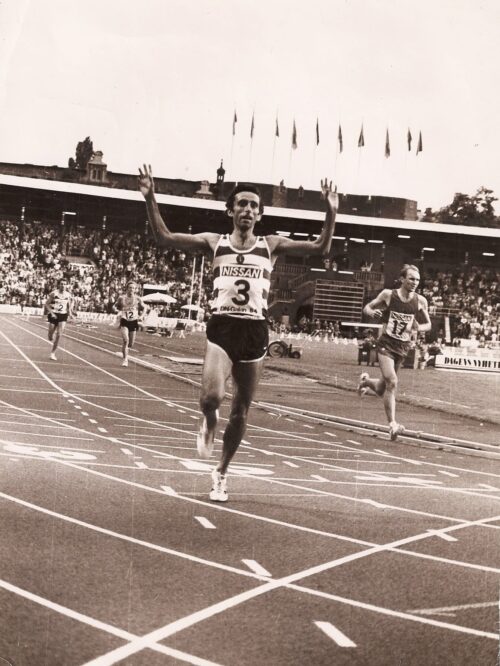
The next day it was his turn to perform. The tanned long-distance runner with raven black hair had been named the world’s best athlete the year before after breaking 12 world records. A packed stadium on July 5, 1966 was hoping for another classic run when Clarke started in the 5,000 meters. But conditions were far from ideal. The star runner had been sick with an upset stomach the night before the race and had no higher hopes than to win the race.
A little misunderstanding meant that the evening unfolded in a way that Clarke could not have imagined. A runner who the Australian thought was one of the runners who would challenge him for the victory pulled ahead. Dizzy from lack of sleep, time changes and toilet visits, Ron Clarke decided to keep up with the high pace set by the unknown runner. It turned out that the man in the lead was not a competitor but a West German hare. When he stepped down, Ron Clarke found himself in the comfortable position of continuing to challenge the clock and having a chance at a world record. The audience’s response was the deciding factor. The fabulous atmosphere that only comes to Stockholm Stadium when a world record is imminent carried the tired Clarke to a time that was better than anyone had ever run in the half-mile. 13.16,6 was the new world record and afterwards the Australian thanked for all the support given to him from the stands.
Ron Clarke first became known to the world when, as an unknown 19-year-old talent, he had the honor of lighting the Olympic flame in his hometown of Melbourne in 1956. He was there to represent the youth and the future. There was no doubt that he was the right man for the job. Ron Clarke dominated long-distance running in the mid-1960s. The only disappointment in his career was his performance at the Olympics, where he only managed to win a bronze medal in Tokyo in 1964. Four years later in Mexico City, he was the big favorite on several legs but he couldn’t handle the thin air.
I had the privilege of meeting Ron Clarke before the Sydney 2000 Olympics. He was living on the Gold Coast in Queensland at the time and there was no shortage of views on how the Olympic Games had developed. Clarke was critical of the power and wealth that the IOC had accumulated.
“Delegates travel first class and see themselves as royalty. The Olympics should be organized for the athletes and less for the sponsors. There are too many sports and the opening ceremonies have degenerated into far too expensive and long events. “
When we met, it had been 44 years since he was the Olympic torchbearer known around the world. He had no trouble summing up his career and legacy to the wider sporting public at home.
“Nine out of ten people in Australia remember me as the guy who lit the Olympic flame. All my world records are long forgotten. In fact, I’m probably best remembered as the brother of my older brother Jack who was a star in Australian football. Unlike me, he really was a great hero in Australia.”
Ron Clarke died in 2015, aged 78.